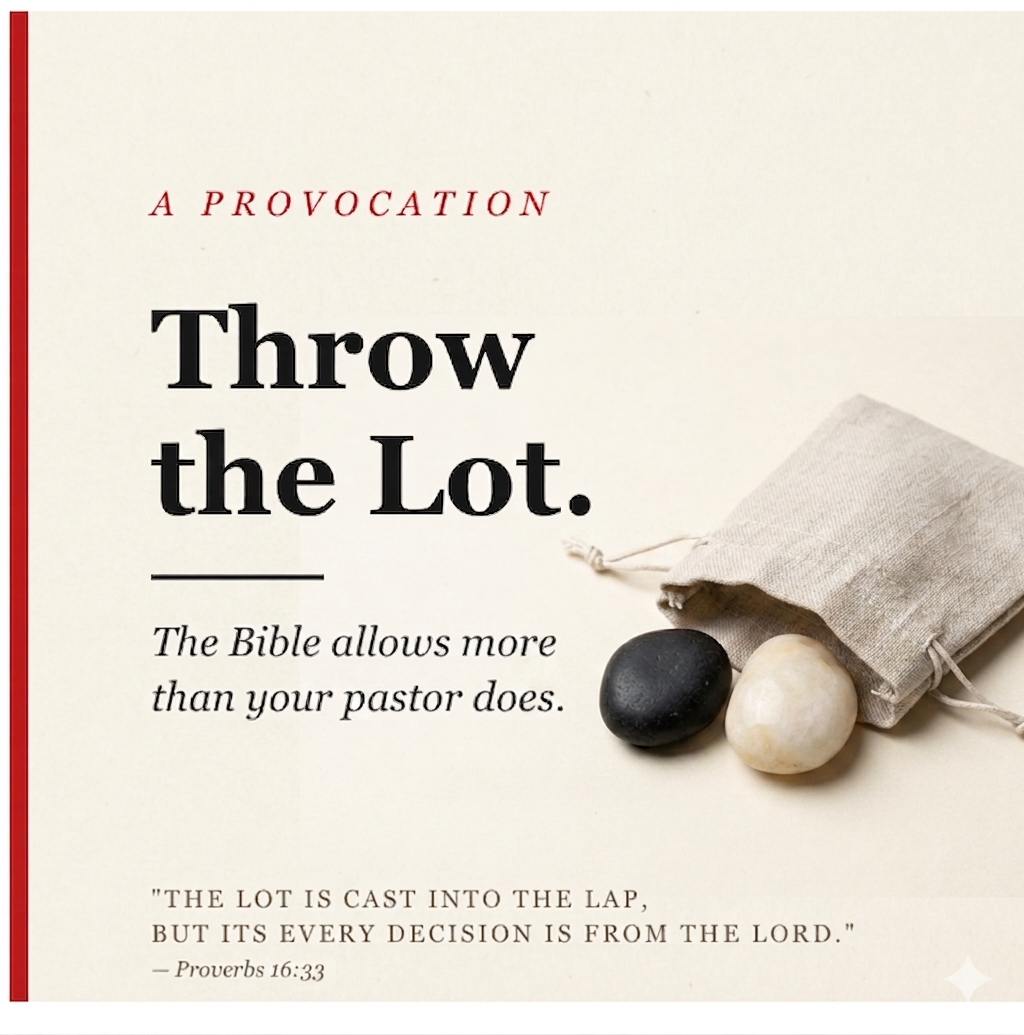
Spoiler: There is no real ban. But some people want you to think there is.
Imagine you have a hard choice to make. A really hard one. You have prayed. You have thought about it. You have talked with friends. And you still don’t know what to do. What if there was a method that the Bible not only talks about, but that God himself set up? A method that kings, prophets, and apostles used?
There is one. It is called casting lots.
And yet, almost every pastor, every teacher, every church leader today will tell you not to do it. Some will give you a strange look. Others will say it is “Old Testament stuff.” Out of date. Not for today. They will tell you that since Pentecost, the Holy Spirit guides us — so we don’t need lots anymore.
It sounds smart. But the Bible does not say this. And if you look closer, you see something else: this is not really about theology. It is about power.
What the Bible actually says
Let’s start with something you cannot argue with: casting lots is not a small thing in the Bible. It is a real tool.
The key verse is Proverbs 16:33:
“The lot is cast into the lap, but its every decision is from the Lord.”
This is not a warning. This is not a limit. This is a promise. God himself decides how the lot falls. That’s it.
And the Bible shows this again and again:
The land under Joshua. When Israel splits up the promised land, they don’t do it by fighting. They don’t do it by age or power. They do it by lot. God himself tells them to do it this way (Numbers 26:55). It is his way to make things fair.
Choosing Matthias. Acts 1:26 — this is in the New Testament, not the Old. The apostles need to replace Judas. Two men are ready: Joseph Barsabbas and Matthias. What do they do? They pray. And then they cast lots. Matthias wins. No angel shows up to stop them. No one says, “Wait, we don’t do it that way anymore.” The text says nothing bad about it.
Purim — the Feast of Lots. Haman, the enemy of the Jews in the book of Esther, casts the “pur” — the lot — to pick the best day to kill all the Jews. But God makes the lot fall in a way that gives Esther time to act. Evil uses the lot — and God wins anyway. A whole Jewish holiday still remembers this today.
The priests at the temple. The work at the temple was also given out by lot. One of these lots sent Zechariah into the Holy of Holies, where an angel told him his son John the Baptist would be born (Luke 1:9). God used the lot to start one of the most important moments in the whole Bible.
The lot is not a pagan thing. It is a Bible thing.
The argument that isn’t an argument
Now here comes the answer you will hear in every Sunday school: “Yes, but after Pentecost, no one cast lots anymore. The Holy Spirit took its place.”
It sounds good. But it isn’t true.
First: there is not one verse in the whole Bible that says this. Not one. The argument is built on silence — on the fact that Acts stops talking about lots after chapter 1. But silence is not a ban. Acts also stops talking about shared meals in Jerusalem after chapter 2. Does that mean the church stopped eating together?
Second: the Holy Spirit and the lot are not rivals. Proverbs 16:33 says God decides how the lot falls. God’s Spirit can work through the lot, just like he can work through prophecy, the Bible, events, or a talk with a friend. No one says, “We don’t need the Bible anymore since Pentecost, because the Holy Spirit speaks to us directly.” So why say it about the lot?
Third — and this is the main point: saying the lot is “out of date” is easy. It is safe. And it protects a certain power system.
Who wins from this?
Think about what happens when Christians can’t cast lots anymore.
The choice moves to someone else. You go to the pastor. To the elders. To your spiritual mentor. You ask, “What should I do?” And someone else tells you what the Holy Spirit is saying. Someone with training. With a title. With power.
This is not by chance. This is a system.
It looks a lot like something church history knows well: clergy holding the keys to meaning. “You are just a normal believer. You can’t understand this. You need a middleman.” This idea kept the Bible away from regular people in the Middle Ages. It was one reason for the Reformation. And in a softer form, it still lives today — for example, when people say, “Yes, God speaks through the Holy Spirit, but only trained people can really hear him right.”
The lot is different. It needs no middleman. It needs no degree. It needs only an honest heart and trust that God does what Proverbs 16:33 says.
And that is why some people don’t like it.
The Church strikes back — but not with the Bible
If you think this worry about casting lots is a new thing, you are wrong. The church has tried to stop it for a long time. But not with Bible verses. With church rules.
In the 5th and 6th centuries, bans started to pile up. The Gallican synods of Vannes (465), Agde (506), and Orléans (511) all threatened to kick out any Christian who cast lots — whether they did it or taught it. A bit later, the synod of Auxerre (570–590) made the rules even stricter. In the Decretals, the church said casting lots is nothing but witchcraft.
But here is the thing. In all these rules, one thing is missing: a single Bible verse to back them up. The synods don’t quote Proverbs. They don’t quote Acts. They don’t quote Joshua. They just say, “We, the church, say so.” That is church power — not Bible truth. The difference is huge.
And then there is Augustine — maybe the strangest witness in this story.
In his 55th Letter, he says clearly that he hates bibliomancy — the way of opening the Bible and taking the first verse your eye sees as a message from God. He does not want anyone to do it. Though he admits it is better than asking demons. That is his official view.
But here is the twist: Augustine became a Christian through this very method. In his Confessions, he tells the story. He is sitting in a garden in Milan. He hears a child’s voice say, “Tolle, lege” — “Take and read.” He picks up the Bible. He opens it. He reads the first verse his eyes land on. It is Romans 13:13–14. And it changes his life.
The irony is huge. The man who is against bibliomancy became a Christian because of it. And the church that bans casting lots got one of its greatest thinkers through exactly this practice.
This shows something important: the story of the ban on lots is not really a story about theology. It is a story about the church keeping control.
But isn’t this dangerous?
Now someone will say, “If everyone can cast lots, people will abuse it!” Maybe. In theory. But in real life, casting lots is not some magic trick. The Bible does not treat it that way either.
The lot works inside a frame. That frame is prayer. Fear of God. A clean heart. The apostles in Acts 1 don’t cast lots on a whim. They pray first. They ask God to speak through the lot. And they already picked two good men to choose from.
The lot does not replace thinking. It does not replace prayer. It does not replace the church. But it is one more tool in the life of faith — a tool God himself gave, and never took away.
The Bible shows both sides: God uses the lot for good (Matthias, the land). And even when someone evil uses it (Haman), God is still in control. The lot is not neutral. The lot is in God’s hand.
What is left
There is no ban in the Bible against casting lots. There is no verse that says, “Not anymore.” There is only a tradition that grew into a rule — with no text to back it up.
Any Christian can cast lots. Not to replace the Holy Spirit. But to show trust that God can speak through any tool he has ever used. This one too.
You don’t need a degree. You need a clean heart. You need honest reasons. And you need trust in a God who is big enough to make a lot fall any way he wants.
And if someone tells you it is not allowed — ask them where the Bible says so. And watch them say nothing.
Share your story
Have you ever cast lots as a Christian? Tell me your story — I want to hear it.